Washington DC is an urban city with trendy neighborhoods like Adams Morgan and Georgetown. If you are thinking of moving to DC browse these pages to find out the pros and cons of each neighborhood, the average rent for an apartment, and the little details that make each neighborhood different and special.
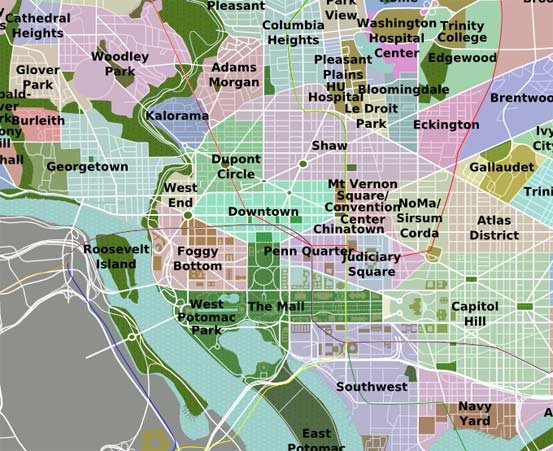
Washington DC is divided into four quadrants: northeast (NE), southeast (SE), southwest (SW), and northwest (NW). The U.S. Capitol is at the center of the city. Although there is a variety of housing in DC, finding an apartment can often be a daunting task. Lack of familiarity with the city and the desire to find an affordable apartment in a safe area can make the process difficult. Remember that the search for housing can take a long time. So the earlier you start, the more options you will have!

Adams Morgan
Who lives here: Young professionals, young families, students, diplomats, immigrants, longtime DC residents.
Location: 18th St NW and Columbia Rd NW.
Transportation: Metro, Metrobus, and DC Circulator. Note: Although the Woodley Park/Zoo/Adams Morgan Station has the name of Adams Morgan, it is a 15-minute walk over the Duke Ellington Bridge or a short bus to the heart of the neighborhood.
Rent for a studio apartment: $1500 and up
Rent for a 1-bedroom apartment: $1600 and up
Pros: Young neighborhood, popular nightlife, hot spot for shopping and dining.
Cons: Lack of parking, considered less safe than other neighborhoods, and distant from the nearest Metro station.

Dupont Circle
Who lives here: Young professionals, young families, and longtime DC residents.
Location: 19th St NW and Connecticut Ave NW.
Transportation: Metro, Metrobus, and DC Circulator. The Dupont Circle Metro Station is conveniently located right in the heart of the neighborhood.
Rent for a studio apartment: $1500 and up
Rent for a 1-bedroom apartment: $1600 - $2000
Pros: Trendy neighborhood, GLBT friendly, with lots of great bookstores, bars and restaurants.
Cons: Expensive, lack of parking.

Chinatown
Who lives here: Professionals who work in Downtown DC. A mixed crowd, a blend of races and ages.
Location: 18th St NW and Columbia Rd NW.
Transportation: Metro, Metrobus, and DC Circulator. The Gallery Place-Chinatown Metro Station connects the neighborhood to the rest of the city.
Rent for a studio apartment: $1600
Rent for a 1-bedroom apartment: $1800 and up
Pros: The neighborhood has new apartment buildings, a vibrant nightlife, restaurants and bars.
Cons: Lack of parking, traffic during rush hour, homeless people and panhandlers, and noisy.

Georgetown
Who lives here: Highly educated professionals, GW students, politicians, lobbyists, and social elite.
Location: M St NW and Wisconsin Ave NW.
Transportation: Metrobus, DC Circulator, by foot.
Rent for a studio apartment: $1500 and up
Rent for a 1-bedroom apartment: $1700 and up
Pros: Upscale neighborhood, surrounded by retail and nightlife.
Cons: Very expensive, no parking, no metro; rentals tend to go to government officials and diplomats rather than students.

Foggy Bottom
Who lives here: Diplomats, World Bank employees, longtime Washington DC residents, and GW students.
Location: Along the Washington DC/Virginia border.
Transportation: Metro and Metrobus. The Foggy Bottom-GWU Metro Station connects the neighborhood to the rest of the city.
Rent for a studio apartment: $1300 - $1600
Rent for a 1-bedroom apartment: $1600 - $1800
Pros: Convenient, upscale neighborhood, close to the George Washington University (GWU) and the Kennedy Center.
Cons: Expensive, no parking, very few studio apartments in the lower rent rate.

Capitol Hill
Who lives here: Young professionals, families, politicos, longtime DC residents.
Location: Center of the city.
Transportation: Metro and Metrobus. The Capitol South Metro Station connects the neighborhood to the rest of the city.
Rent for a 2-bedroom row house: starts at $2500
Rent for a 3- and 4-bedroom house: starts at $3000
One bedroom and studio apartments are available, but prices vary greatly.
Pros: Old historical neighborhood with culinary and cultural attractions, such as the U.S. Capitol, the Library of Congress, and the Supreme Court.
Cons: Lack of parking.
Neighborhoods Around Washington DC
Old Town Alexandria
Who lives here: Federal and military personnel, families
Distance to DC: 20 min.
Transportation: Metro, DASH, Fairfax Connector.
Rent for a studio apartment: $1200 and up
Rent for a 1-bedroom apartment: $1500 and up
Pros: Restored historic houses with shops, restaurants, and bars.
Cons: Traffic, lack of street, flooding risk.
Silver Spring, Maryland
Who lives here: Families, young professionals
Distance to DC: 30-35 min.
Transportation: Metro, bus.
Rent for a studio apartment: $1000 - $1200
Rent for a 1-bedroom apartment: $1300 and up
Pros: the beltway, large shopping districts, urban feel.
Arlington, Virginia
Who lives here: Families, young professionals, students
Distance to DC: 5-15 min.
Transportation: Metro, bus, highway, back roads.
Rent for a studio apartment: $1200
Rent for a 1-bedroom apartment: $1400
Pros: Urban villages, such as Ballston, Clarendon, Court House, Crystal City, Rosslyn, and Virginia Square, are built around Metro stations making it easy to live, work, shop, and play within a walkable, pedestrian-friendly environment. Young crowd with local retail and nightlife.
Cons: Expensive, lack of street parking.