


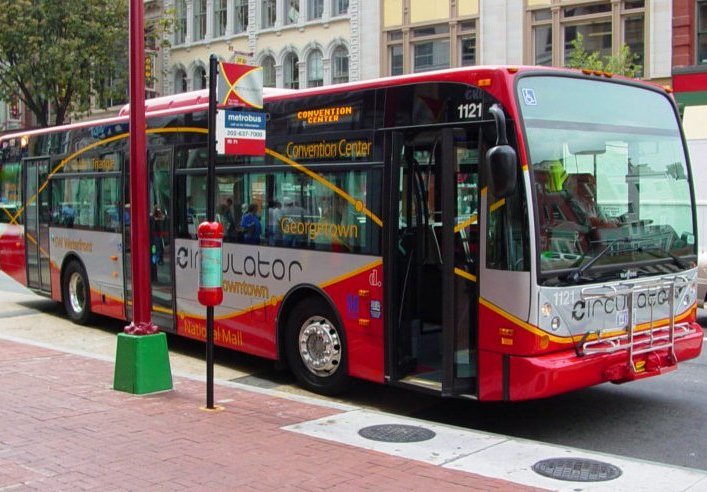
DC Circulator Fares
|
Regular |
$1.00 dollar |
|
Senior/Disabled |
$0.50 cents |
|
Children Under 5 |
Free with a paying adult |
|
DC Students (elementary through high school) |
Free with DC Student Travel Card |
DC Circulator Farecards
The bus fare can be paid using cash, SmarTrip card, or DC Circulator passes. If paying with cash, exact change is required because bus drivers do not carry cash.
 SmarTrip Card: a rechargeable, plastic farecard that can be used to pay fares and transfers on the DC Circulator bus, Metrobus, Metro, and Metro parking. The card is available for purchase online at CommuterDirect.com and in person at Metro Center and at participating CVS Pharmacies, Safeway, Giant and other locations.
 DC Circulator Passes: ride all you want by purchasing unlimited-trip passes. One-Day ($3), 3-Day ($7), Weekly ($11) and Monthly ($40) passes are available for purchase through CommuterDirect.com
Bus Transfers
The DC Circulator uses a paperless transfer system. Paper transfers are no longer issued or accepted. To receive a transfer, a SmarTrip card must be used to pay the bus fare. Passengers using cash do not get a transfer and must pay the full fare when transferring to Metro or Metrobus.
|
DC Circulator to Another DC Circulator |
Free within 2 hours |
|
DC Circulator to Metrobus |
Free within 2 hours |
|
DC Circulator to Metro |
$0.50 discount of the Metro fare |
|
Metro to DC Circulator |
$0.50 cents |
|
Metro (Senior/Disabled) to DC Circulator |
Free |
|
ART to DC Circulator |
Free |
DC Circulator Routes
The DC Circulator has various bus routes. All routes cross each other and are designed to make transfers easy. Although buses run every 10 minutes, each route has a different bus schedule.
The most popular bus route is the Georgetown - Union Station, which connects Georgetown to the metro stations in Union Station and Chinatown. This provides an easy way to get to Georgetown from other areas in Washington DC, as there is no metro station anywhere near Georgetown.
 Georgetown - Union Station
 Potomac Avenue Metro to Skyland via Barracks Row
 Union Station - Navy Yard via Capitol Hill
 Woodley Park - Adams Morgan - McPherson Square Metro
Where is my Bus?
Are you wondering when the next DC Circulator is going to arrive? "Where is my Bus?" is an app for mobile devices that allows you to have up-to-the-minute location information about DC Circulator buses.
Using any mobile device, go to circulator.dc.gov and select your DC Circulator route and bus stop. "Where's My Bus?" will use real-time GPS data to tell you how close the next few DC Circulator buses are and whether there are any service disruptions you should know about.
Is the DC Circulator similar to Metrobus?
Using the DC Circulator bus is easier than traveling via Metro or Metrobus. However, you might need to know the following when riding the DC Circulator:
Unlike Metrobus, the DC Circulator bus does not have a digital screen or an announcer to let passengers know which bus stop is next. So, pay attention to the roads and know where you are. The bus drivers are friendly and know their routes well, so don't be afraid to ask for help if needed.
Unlike Metrobus, the DC Circulator bus does not have yellow cords to indicate the bus driver that you are getting off at the next bus stop. Instead, the DC Circulator bus has yellow and red buttons located on the arm rails or walls of the bus. Press any of these buttons to indicate the driver that you will be getting off.
Related Articles
DC Circulator
The DC Circulator bus, also known as the red bus, is a fast and inexpensive transportation system, connecting areas that aren't well served by Metro. The buses are clean and comfortable with low floors, big tourist-style windows, European-style seating, and multiple doors for easy on-and-off service.
The DC Circulator bus has six color-coded bus routes. Although each bus route has a different bus schedule, all buses arrive every 10 minutes at every bus stop. Passengers can get a DC Circulator map when boarding the bus. However, be sure to check the map before your bus trip to identify which bus stop is the closest to your destination.
The DC Circulator bus is easily recognized by its red, black and yellow-striped colors. Most of the passengers riding the bus are young professionals, and the occasional tourist savvy enough to have figured out how to get around Washington DC quickly and easily.
DC Circulator bus stops are identified by red, silver and yellow circular tubes with signs that provide information about the bus route. The bus stops often coincide with metrobus stops. So, you might see DC Circulator signs next to the blue, white, and red metrobus signs.
If this is your first time riding the DC Circulator bus, plan your trip using Google Maps within Washington DC. When getting directions from Google Maps, select the "By public transit" option. If there is at least a DC Circulator bus transiting through the area, it will be displayed in the results. The results are often combined with walking directions.

Inside the DC Circulator.

Press the "Stop" request button to indicate the bus driver that you are getting off.
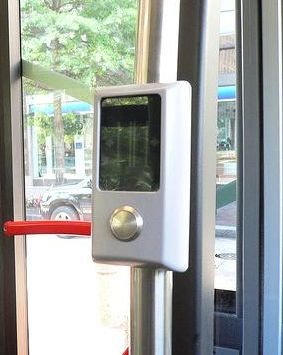
Press the "Door Open" request button when you are at the back of the bus.